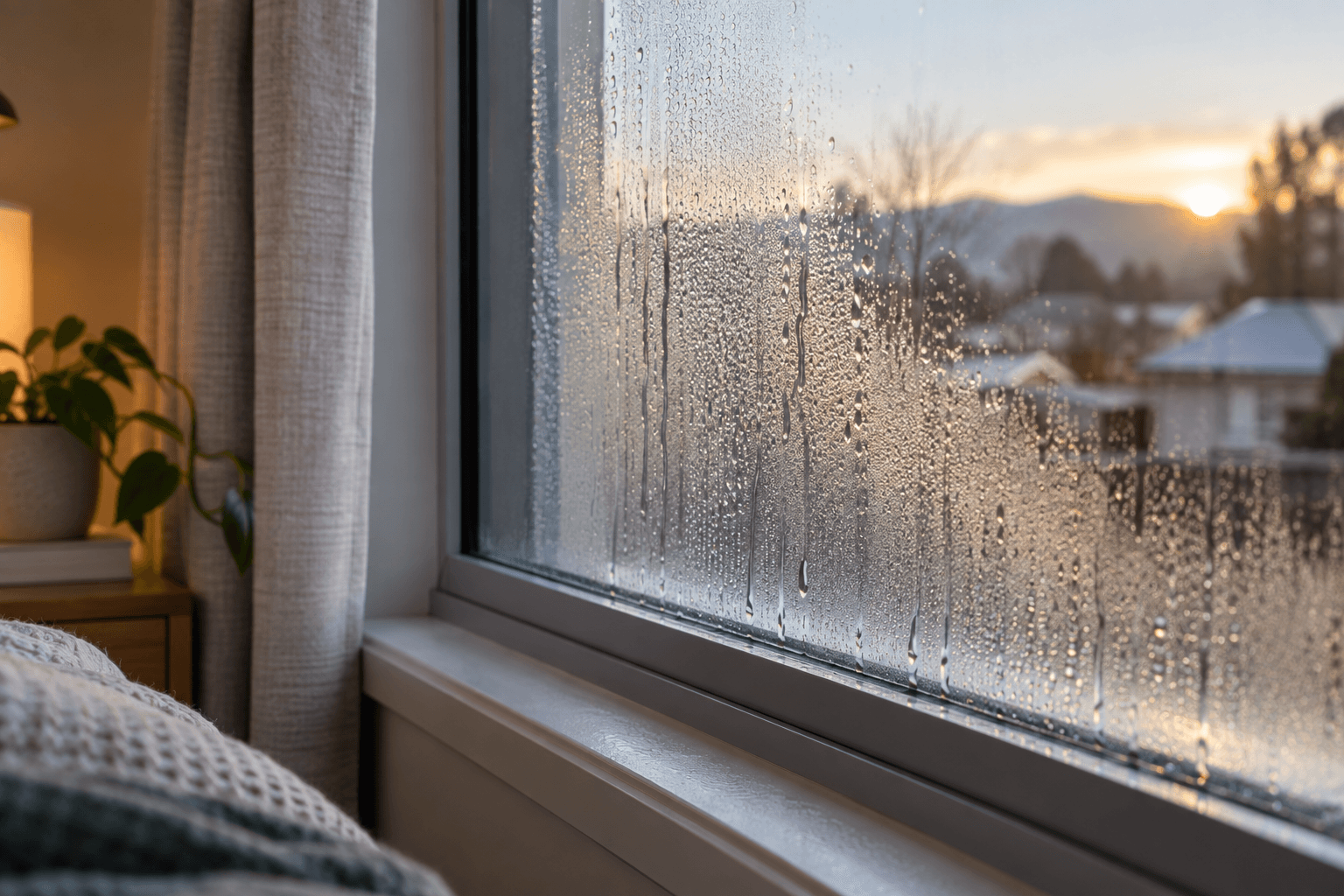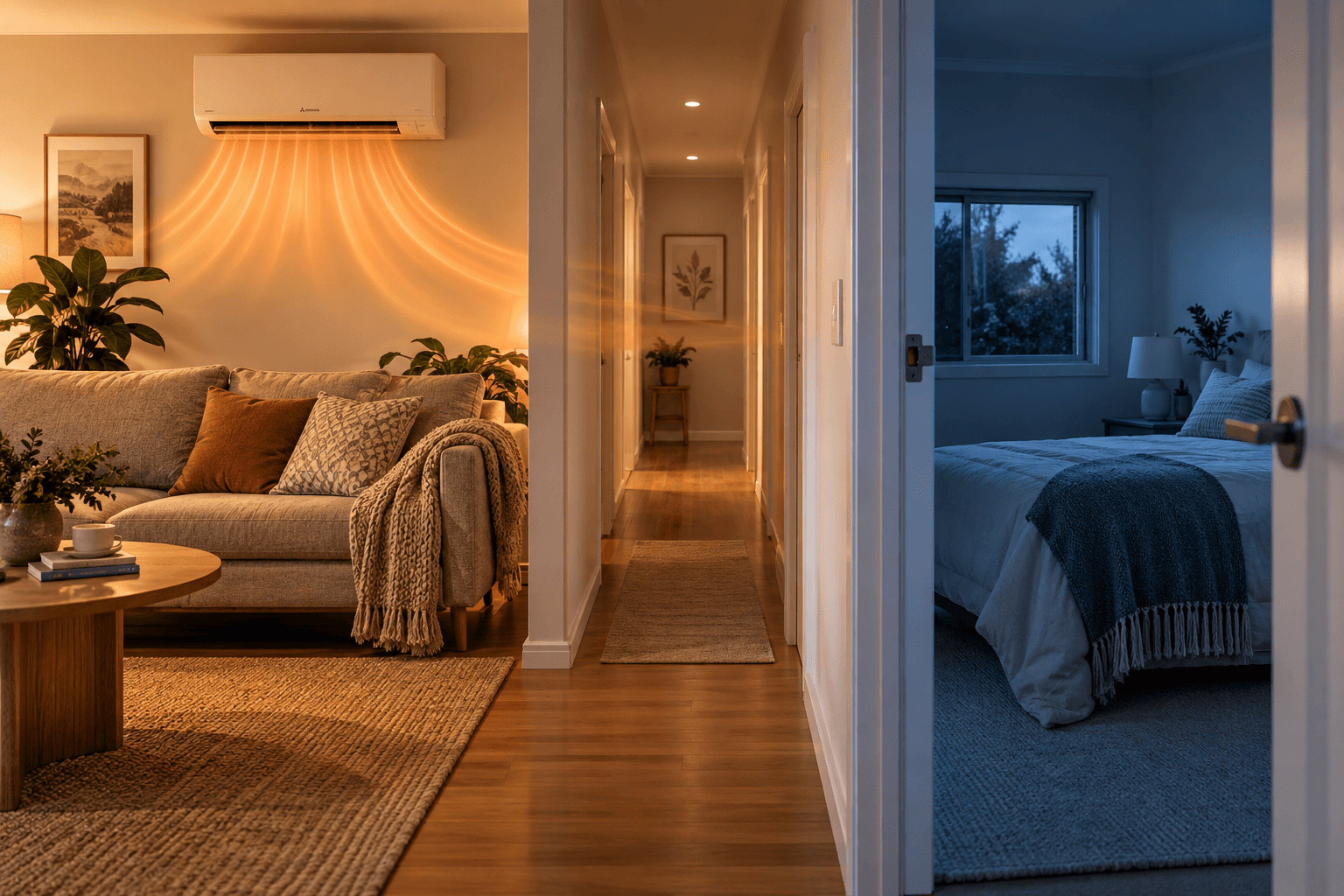

A heat pump is installed in the lounge. It warms the room quickly, maintains a comfortable temperature and seems to be doing exactly what it was purchased to do.
But what about the rest of the house?
Will that warmth travel through the dining area, down the hallway and into the bedrooms? Or will the lounge become increasingly warm while other rooms remain cold?
It's a reasonable question, particularly if you're planning a new installation and hoping one heat pump will be enough for the whole home.
The answer depends on more than the size or power of the heat pump.
To understand what one unit can realistically achieve, it helps to separate two things that are often treated as though they're the same.
Producing enough heat and getting that heat to the rooms where it's needed are two different challenges.
Heating One Room and Heating a Whole House Are Different Jobs
A wall-mounted heat pump is designed to heat and cool the space it serves.
It draws air through the indoor unit, conditions that air and circulates it back into the room. As the system operates, it works to maintain the selected temperature using its controls and temperature sensors.
In an open-plan living area, that circulation can help distribute warmth across a relatively large connected space.
But a house is rarely one completely open room.
There may be walls separating the lounge from the kitchen, a hallway leading to the bedrooms, doors that remain closed overnight and rooms that are used at different times of the day.
Those features change how easily conditioned air can move from one part of the home to another.
A heat pump may have sufficient heating capacity for a large area without being able to distribute that warmth effectively into every separate room.
That's why a comfortable lounge doesn't automatically mean the entire house will be comfortable.
Why Doesn't Warm Air Simply Travel Through the House?
Warm air can move between connected spaces, but it doesn't necessarily travel far enough, or in sufficient quantities, to maintain comfortable temperatures throughout a house.
Consider a lounge with a heat pump mounted on an external wall.
The indoor unit circulates air through the living area. Some of that warmer air may move through an open doorway into the hallway, particularly as air moves around the house.
But the hallway may turn a corner. Bedroom doors may be partly closed. Other rooms may be losing heat through their windows, ceilings, walls and floors.
By the time warmth reaches those rooms, the amount of heat arriving may be much less than the amount needed to keep them comfortable.
Simply producing more warm air in the lounge doesn't necessarily overcome those barriers.
This is why the shape of the home matters just as much as its total floor area when deciding whether one heat pump can serve several rooms.
When Can One Heat Pump Work Well Across a Larger Space?
A single heat pump can be a very practical solution for a large, connected living area.
Imagine a home where the lounge, dining room and kitchen form one continuous space. There are few walls interrupting airflow, and the indoor unit can be positioned to circulate conditioned air effectively throughout the area.
If the system is appropriately sized and the home retains heat reasonably well, one heat pump may be able to provide comfortable conditions across that connected living zone.
The important distinction is that an open-plan living area is not necessarily the same thing as the entire house.
A heat pump that works well across the lounge, dining room and kitchen may still have little influence over bedrooms at the opposite end of the home.
Even within open-plan spaces, ceiling height, glazing, insulation and positioning can affect the result.
That's why choosing the right system involves more than measuring the floor area.
Our article What Size Heat Pump Do I Need for My Home? explains why two spaces with the same floor area can have very different heating and cooling requirements.
What Happens When Bedrooms Are Separated From the Living Area?
Bedrooms are often where the limitations of a single wall-mounted heat pump become most noticeable.
During the evening, the family may spend most of its time in the lounge. The heat pump keeps that space comfortable, and everything appears to be working well.
Later, when someone walks down the hallway to go to bed, the bedrooms feel noticeably colder.
The heat pump hasn't necessarily failed.
It may simply be heating the area it was installed to serve.
Bedrooms can be separated by walls, hallways and doors. They may also have different glazing, insulation, sun exposure and heating requirements from the living area.
Even when some warm air reaches a bedroom, that room may lose heat faster than the incoming warmth can replace it.
Leaving doors open may allow more air movement, but it doesn't guarantee that the bedrooms will reach the same temperature as the lounge.
This is a different problem from a heat pump that cannot adequately heat the room in which it is installed.
If your lounge is warm but the bedrooms remain cold, our article Why Is My Lounge Warm but My Bedrooms Still Cold? explores those causes in more detail.
Would Installing a Bigger Heat Pump Solve the Problem?
This is a common assumption.
If one heat pump isn't warming the entire house, perhaps a larger unit would produce enough heat to reach the other rooms.
But increasing the heating capacity doesn't automatically improve how air moves through the building.
A larger heat pump may be capable of producing more heat, but that heat still needs a practical route into the rooms where it's required.
If walls, hallways and closed doors restrict airflow, increasing the capacity of the lounge unit may do little to solve the underlying distribution problem.
You could end up with a lounge that reaches its target temperature while the bedrooms remain uncomfortable.
The better question is not simply whether the heat pump is powerful enough.
It's whether the system can deliver the required heating to the spaces you actually want to keep warm.
That distinction matters when deciding whether to replace an existing unit or consider another approach.
How Much Difference Do Insulation and Glazing Make?
Getting heat into a room is only part of keeping it comfortable.
The room also needs to retain enough of that heat.
During winter, warmth is continually lost through the building envelope, including ceilings, walls, floors and windows.
How quickly that happens depends partly on the insulation, glazing, draughts and construction of the home.
Consider a bedroom that receives a small amount of warmth from the lounge.
If the bedroom is well insulated and has relatively good thermal performance, that incoming warmth may have a more noticeable effect.
If the bedroom loses heat quickly through older glazing, insufficient insulation or unwanted draughts, the same amount of incoming warmth may make relatively little difference.
This explains why two houses with similar layouts can respond differently to a single heat pump.
The heating system and the home itself work together to determine the comfort people experience.
It also means that adding more heating equipment isn't always the only improvement worth considering.
What If You Want the Bedrooms Comfortable Too?
Once the objective changes from heating one living area to providing comfort across several rooms, the options become broader.
Another individual heat pump may be a practical approach where separate areas need their own heating and cooling.
For example, a second unit might serve a bedroom area or another living space that is physically separated from the main lounge.
A heat transfer system works differently. Rather than generating additional heat, it moves some of the useful warmth already available in one part of the home to another.
That can make sense in suitable situations, but it depends on having sufficient warmth available to transfer. Moving heat away from one room also affects the heat remaining there.
Ducted heat pump systems take another approach.
Instead of relying on one wall-mounted indoor unit to circulate air through doorways and hallways, a ducted system uses ductwork and outlets to distribute conditioned air to the rooms it is designed to serve.
This can provide a more direct way of heating and cooling several rooms, although the layout of the house and available space for ducting and equipment affect whether it's practical.
These options aren't interchangeable, and none is automatically the best choice for every home.
The right direction depends on what the homeowner wants to achieve and how the house is arranged.
A Single Heat Pump Doesn't Always Mean a Single Heated Room
There is another distinction worth understanding.
When people ask whether one heat pump can heat a whole house, they're often thinking about a single wall-mounted indoor unit in the lounge.
But not every heat pump system is configured that way.
A ducted heat pump can use one central indoor unit connected to ductwork that delivers conditioned air to multiple rooms.
Some multi-split systems can also connect multiple indoor units to a single outdoor unit, allowing separate spaces to be served.
So the number of outdoor units isn't necessarily what determines whether a system can heat several rooms.
What matters is how the system is designed to deliver heating and cooling throughout the home.
A single wall-mounted unit trying to warm distant bedrooms through open doorways is a very different arrangement from a system designed to condition those bedrooms directly.
Start With What You Want the Whole House to Feel Like
Before deciding whether one heat pump is enough, it helps to be clear about what you're actually trying to achieve.
Perhaps you're happy for the bedrooms to remain cooler, and your main priority is a comfortable lounge, dining room and kitchen.
In that situation, one appropriately selected heat pump may be a sensible solution.
But perhaps you want comfortable bedrooms during winter mornings, a warm living area in the evenings and effective cooling across several rooms in summer.
That is a different requirement.
The layout of the home, the rooms being used, the time of day and the level of comfort expected all become important.
An older home with a long hallway and separated bedrooms may need a different approach from a newer open-plan home, even if both have a similar total floor area.
That's why the starting point should be the comfort you're trying to achieve throughout the house, rather than the number of heat pumps you hope to install.
Common Questions About Heating a Whole House With One Heat Pump
Can one heat pump heat a three-bedroom house?
A single wall-mounted heat pump may provide useful warmth beyond the room where it is installed, but it will not necessarily heat all three bedrooms comfortably. The result depends on the house layout, airflow, insulation, glazing and room separation. If consistent bedroom heating is important, a system designed to serve those rooms may be more suitable.
Will leaving bedroom doors open help heat reach them?
Leaving doors open can allow more air to move between rooms, which may help some warmth reach the bedrooms. However, the result depends on the home's layout and how much heat each room loses. Open doors do not guarantee even temperatures throughout the house.
Can a bigger heat pump heat more rooms?
A larger heat pump can provide greater heating capacity, but it does not automatically improve heat distribution into separated rooms. Walls, hallways, doorways and airflow restrictions can still prevent sufficient warmth from reaching other parts of the house.
Does a heat pump in the hallway heat bedrooms?
A hallway installation may influence adjoining rooms, but the result depends on the layout, airflow, unit placement and whether bedroom doors are open or closed. Hallways can also provide limited options for effective air circulation. The system should be assessed against the rooms it is expected to heat.
Can one heat pump heat upstairs and downstairs?
A single wall-mounted heat pump may influence temperatures across connected levels, but it should not be assumed to provide comfortable heating throughout both floors. Stairwells, room separation, heat movement and the thermal characteristics of each level can affect the result.
Is ducted heating the only way to heat an entire house?
No. Depending on the home, multiple individual heat pumps, multi-split systems, ducted heating or suitable combinations of heating approaches may be considered. Heat transfer can also help redistribute existing warmth in some situations. The appropriate option depends on the home's layout and the comfort required in different rooms.
Final Thoughts
One heat pump can be an excellent way to heat and cool a living area. In some homes, it may also provide useful warmth to adjoining spaces.
But producing enough heat and distributing that heat throughout an entire house are not the same thing.
A system can be working well in the lounge while bedrooms remain cold because the warmth simply isn't reaching them in sufficient quantities.
The layout of the house, its insulation, glazing, airflow and the way different rooms are used all influence what one heat pump can realistically achieve.
So rather than asking whether one heat pump should be enough for the whole house, it is often more useful to ask:
Which rooms do we want comfortable, and what is the most practical way to deliver heating and cooling to them?
That is where a whole-home approach begins.
Want More Than Just a Warm Lounge?
Climate Systems looks at the home as a whole before recommending a heating and cooling solution.
We consider how the rooms connect, where comfort is needed, how the home retains heat and what you want the system to achieve.
Whether the answer involves one heat pump, several units, ducted heating or another suitable approach, the goal is the same.
Fix the comfort problem, not just one room.