
Published 13 September 2026
Why Is My Lounge Warm but My Bedrooms Still Cold?
Article Summary
If your lounge is warm but your bedrooms are still cold, the heat pump may be working properly in the room it serves while the rest of the house is not receiving or retaining enough heat. House layout, hallways, closed doors, insulation, glazing and heat loss can all affect bedroom temperatures. The right solution may involve another heat pump, heat transfer, ducted heating, improvements to the home itself, or a combination, but the first step is understanding why the bedrooms are cold.
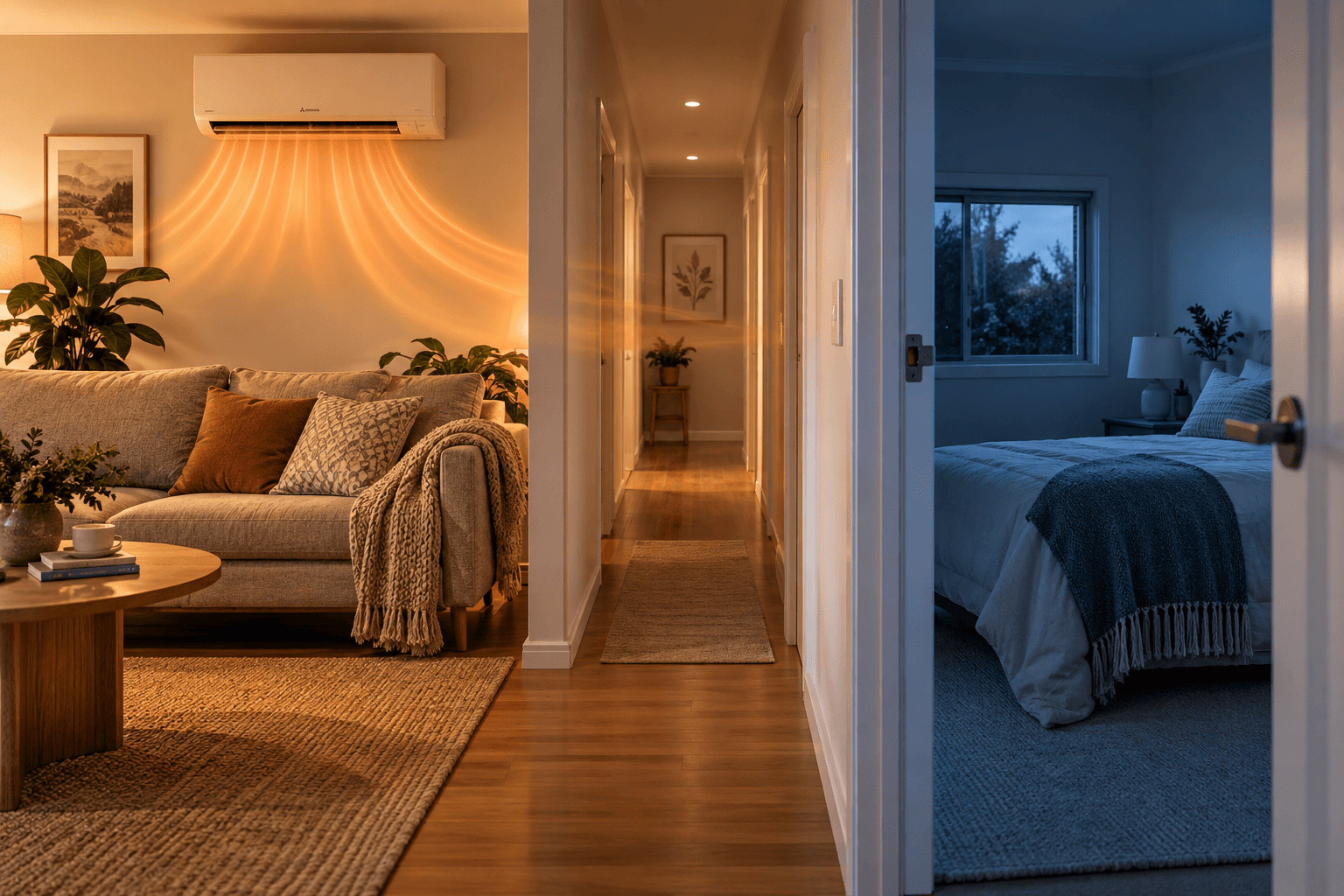
Your heat pump is on. The lounge feels warm and comfortable. But walk down the hallway and the bedrooms still feel cold.
It is easy to assume that something must be wrong with the heat pump. But if it is successfully heating the lounge, the problem may be less about how much heat the system is producing and more about what happens to that heat once it enters the room.
A house is not one open space. Walls, hallways, doorways and closed rooms all affect how warm air moves through it. At the same time, different rooms can lose heat at different rates depending on their insulation, glazing, draughts and position within the home.
So before deciding that you need a bigger heat pump, another heat pump or a completely different heating system, it helps to understand why the bedrooms are cold in the first place.
Why Is My Lounge Warm but My Bedrooms Still Cold?
Your heat pump is on. The lounge feels warm and comfortable. But walk down the hallway and the bedrooms still feel cold.
It is easy to assume that something must be wrong with the heat pump. But if it is successfully heating the lounge, the problem may be less about how much heat the system is producing and more about what happens to that heat once it enters the room.
A house is not one open space. Walls, hallways, doorways and closed rooms all affect how warm air moves through it. At the same time, different rooms can lose heat at different rates depending on their insulation, glazing, draughts and position within the home.
So before deciding that you need a bigger heat pump, another heat pump or a completely different heating system, it helps to understand why the bedrooms are cold in the first place.
Heating the Lounge and Heating the House Are Two Different Things
A wall-mounted heat pump can do an excellent job of heating the room or area it serves. That does not necessarily mean the warmth will spread evenly throughout the rest of the house.
Think about an open-plan kitchen, dining and living area. There may be very few barriers between those spaces, so heated air has a relatively easy path around them.
Now think about a bedroom at the other end of the house. The warmth may need to move out of the lounge, around a corner, along a hallway and through a bedroom doorway before it reaches the space you actually want to heat.
Close that bedroom door and the room becomes even more separated from the heated area.
This is why a warm lounge and cold bedrooms do not automatically mean the heat pump is too small or isn't working properly. The heat pump may be successfully doing what it was installed to do in the living area.
The real issue may be that you are trying to use one heated space to provide comfort to several separate rooms.
Why Doesn't the Warm Air Just Travel Down the Hallway?
Warm air can move into other parts of the house, particularly when doors are open and the layout allows air to circulate. But that does not mean every room will eventually reach the same temperature.
The shape of the house matters.
A bedroom directly off an open living area is quite different from a bedroom down a long hallway. Corners, narrow doorways and separate rooms make it more difficult to distribute conditioned air evenly.
How you use the house matters too.
Leaving bedroom doors open may allow more warm air into those rooms, but many households close bedroom doors at night for privacy, noise or simply because that is how they use their home. A heating solution that only works when every internal door remains open may not match the way the household actually lives.
This is why whole-home comfort needs to be considered around the home and the people living in it, rather than simply around the capacity of the heat pump in the lounge.
Getting Heat Into the Bedroom Is Only Half the Problem
There is another part of the equation that is easy to overlook.
Even if some warmth reaches the bedroom, how well does that room hold onto it?
Heat naturally moves from warmer areas towards colder ones, and a home's thermal envelope affects how quickly that heat is lost. Insulation slows heat transfer through ceilings, walls and floors, while windows, frames, draughts and other parts of the building can also influence heat loss.
That means two bedrooms in the same house do not necessarily behave in exactly the same way.
One might receive more afternoon sun. Another might have more external wall area. One may have upgraded glazing while another has older windows. There may be differences in insulation or draughts around windows and doors.
This gives you two separate questions to think about.
Can enough heat get into the bedroom?
And:
Once it gets there, can the bedroom retain enough of that heat to stay comfortable?
Those questions sound similar, but they can lead to very different solutions.
Getting Heat Into the Bedroom Is Only Half the Problem
There is another part of the equation that is easy to overlook.
Even if some warmth reaches the bedroom, how well does that room hold onto it?
Heat naturally moves from warmer areas towards colder ones, and a home's thermal envelope affects how quickly that heat is lost. Insulation slows heat transfer through ceilings, walls and floors, while windows, frames, draughts and other parts of the building can also influence heat loss.
That means two bedrooms in the same house do not necessarily behave in exactly the same way.
One might receive more afternoon sun. Another might have more external wall area. One may have upgraded glazing while another has older windows. There may be differences in insulation or draughts around windows and doors.
This gives you two separate questions to think about.
Can enough heat get into the bedroom?
And:
Once it gets there, can the bedroom retain enough of that heat to stay comfortable?
Those questions sound similar, but they can lead to very different solutions.
Would a Bigger Heat Pump in the Lounge Fix the Problem?
Not necessarily.
If the lounge is already reaching a comfortable temperature, increasing the amount of heat being produced in that room does not automatically improve the path between the lounge and the bedrooms.
This is an important distinction.
Heat-pump sizing matters. A system needs to be appropriate for the space it is expected to heat and cool. But heating capacity and heat distribution are not the same thing.
A larger heat pump may be able to produce more heating output, but the house still has the same walls, hallway, doorways and separate rooms.
This is one reason heat-pump selection should not be based on floor area alone. The layout of the home, insulation, glazing, ceiling height, sun exposure and how the rooms are actually used can all affect what sort of system makes sense.
If the existing heat pump is comfortably heating the lounge, the better question may not be, “How do we get more heat from this unit?”
It may be, “How do we get the right amount of heating into the bedrooms?”
Could Another Heat Pump Be the Answer?
Sometimes it can be a very practical solution.
If the home has two distinct areas that need heating and cooling, providing those areas with their own heat pumps can allow them to be controlled independently.
For example, the living area may need to be comfortable during the afternoon and evening, while the bedrooms are more important later at night and first thing in the morning. Separate systems can suit that pattern because you are producing heating or cooling where and when it is needed.
But adding another heat pump should still start with understanding the problem.
If several bedrooms need more consistent heating and cooling, installing individual units may not be the only option worth considering. The layout of the house and the result the homeowner wants can make other approaches worth investigating.
What About Heat Transfer?
Heat transfer is often considered when one part of a house is warm and another is cold.
The important thing to understand is that a heat-transfer system does not create heat. It moves available warm air from one part of the house to another.
That distinction matters.
If there is useful excess heat available in the lounge, moving some of it towards another part of the home may be helpful in the right situation. But the effectiveness of that approach depends on the amount of heat available, where it needs to go and what happens once it reaches the destination room.
If a bedroom is losing heat quickly, simply moving some warmer air towards it may not produce the result the homeowner expects.
So the question is not simply, “Does heat transfer work?”
It is whether moving existing heat is the right solution to the particular comfort problem in your home.
When Does Ducted Heating Make More Sense?
For homeowners who want heating and cooling across several rooms, a ducted heat-pump system may be worth considering.
Rather than relying on warmth to find its way from a wall-mounted unit in the lounge to other rooms, a ducted system is designed to deliver conditioned air to multiple areas of the home.
That can make it attractive when the goal is broader, more consistent comfort rather than heating one or two individual spaces.
But ducted heating is not automatically the best answer simply because several rooms are cold.
The house needs to be suitable for the equipment and ductwork, and the homeowner's priorities matter. In some homes, separate heat pumps may provide a simpler and more practical solution. In others, ducted heating may fit the way the household wants to use the home.
The system should follow the problem, not the other way around.
Sometimes the Heating System Isn't the Only Thing to Look At
If a bedroom is difficult to keep warm, it is worth considering the room itself as well as the heating system.
Insulation reduces the rate at which heat escapes through the building envelope. Windows and doors can also be significant areas of heat loss, particularly where glazing or frames have lower thermal performance or where draughts are present. New Zealand building guidance specifically identifies ceilings, walls, floors and windows as parts of the thermal envelope that influence how easily a home retains warmth.
That does not mean every cold bedroom needs an insulation or glazing upgrade.
It means that adding more heating without considering heat loss can sometimes address only one side of the problem.
A useful assessment therefore looks at both.
How are we going to get enough heat into this room, and what happens to that heat once it is there?
Start With the Comfort Problem, Not the Product
When the lounge is warm but the bedrooms are cold, there is rarely much value in choosing a solution before understanding why the temperature difference exists.
Start with how the house behaves.
Where is the existing heat pump? Which areas does it comfortably heat? How are the bedrooms separated from that space? Are bedroom doors normally open or closed? Are all of the bedrooms cold, or is one noticeably worse than the others? How well insulated is the home? What type of glazing does it have? When do the bedrooms actually need to be warm?
Then think about the result you want.
Perhaps you only want additional heating in one bedroom. Perhaps there are two separate areas of the house that need independent control. Perhaps you want several bedrooms and living areas maintained at a more consistent temperature.
Those are different comfort problems, so it makes sense that they may need different solutions.
Another heat pump might be right. Heat transfer might make sense. A ducted heat pump might better suit the desired result. Improvements to insulation, glazing or draught control may also form part of the picture.
Sometimes a combination is the sensible answer.
The important thing is not to assume that because the lounge has a heat pump, the next step is simply to make that heat pump bigger.
If the lounge is already comfortable, start by finding out why the bedrooms aren't.
Common Questions About Warm Lounges and Cold Bedrooms
Why are my bedrooms cold when the heat pump is on?
If the room containing the heat pump is warm but the bedrooms remain cold, the heat pump may be heating its immediate area successfully without enough warmth reaching the separate bedrooms. The home's layout, distance between rooms, closed doors and heat loss from the bedrooms can all affect the result.
Will leaving the bedroom doors open make the rooms warmer?
Leaving doors open can make it easier for warm air to move between spaces, so it may help in some homes. However, it does not guarantee that enough heat will reach a bedroom to keep it comfortable, particularly if the room is a long way from the heat pump or loses heat quickly.
Can one heat pump heat a whole house?
It depends on the house. A heat pump can influence adjoining spaces, particularly where the layout is relatively open, but one wall-mounted unit should not automatically be expected to heat every separate room effectively. Layout, heat loss, system placement and how the household uses the rooms all matter.
Would installing a bigger heat pump make my bedrooms warmer?
Not necessarily. If the existing heat pump already heats the lounge comfortably, additional capacity in the same location does not remove the walls, hallways and doorways between the unit and the bedrooms. It is important to establish whether the problem is heating capacity, heat distribution, heat loss or a combination of factors.
Is heat transfer a good option for cold bedrooms?
It can be in the right situation. Heat transfer moves existing warm air from one part of the home towards another rather than generating additional heat. Whether that is suitable depends on how much useful heat is available, the layout of the home and the heating needs of the destination rooms.
Is another heat pump better than ducted heating?
Neither option is automatically better. Another heat pump can be practical when separate areas need independent heating and cooling. Ducted heating may be worth considering when the goal is heating and cooling across several rooms. The house layout, available installation space and the result you want should guide the decision.
Want the Whole House to Feel More Comfortable?
If one room is warm while the rest of the house is still uncomfortable, Climate Systems can look at the home as a whole rather than simply recommending another unit.
Our Whole Home Comfort approach considers how the house is laid out, where heating is needed, how the rooms are used and what may be contributing to the comfort problem before looking at the options.
Fix the comfort problem, not just one room.