Article Summary
Condensation forms on windows when moisture in the air inside your home meets glass or window frames that are cold enough for that moisture to turn into water. That is why condensation is often worse during winter. How much appears can be influenced by the amount of moisture being produced inside the home, how effectively that moisture is removed, how the home is heated, and the temperature of surfaces such as windows. Ventilation can be part of the solution, but wet windows do not automatically mean you need a ventilation system.
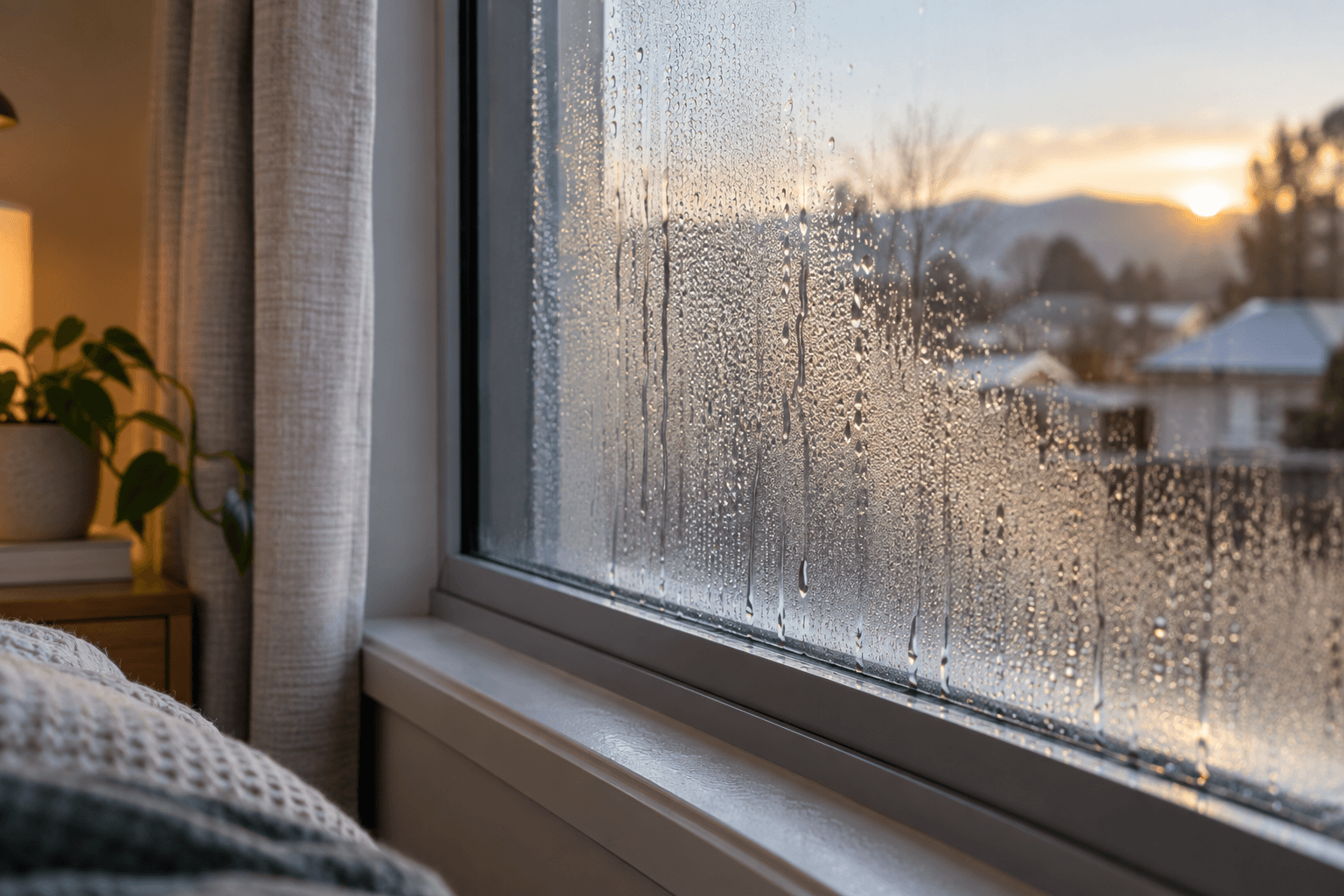
You wake up on a cold winter morning, open the curtains and the inside of the bedroom window is covered in water.
Sometimes it is a light mist across the glass. Other mornings there can be enough water to run down the window and collect on the sill.
The obvious question is: where did all that water come from?
It did not come through the glass. In most cases, the water was already inside your home as moisture in the air.
Understanding how that moisture becomes condensation is useful because the wet window is only the visible part of the problem. Wiping the glass removes the water you can see, but it does not explain why it formed.
And before deciding that the answer is a ventilation system, more heating, double glazing or something else, it helps to understand what is actually happening inside the home.
surrounding air is condensing against the cold surface.
The same basic process can happen to the windows in your home.
That also explains why simply asking, "How do I stop my windows getting wet?" can lead you in the wrong direction.
The better question is:
Why is there enough moisture and a cold enough surface for condensation to form in my home?
Where Does All That Moisture Come From?
A surprising amount of moisture can be produced through ordinary daily life.
Every time someone showers, cooks or dries washing indoors, additional moisture can enter the air. Even the people living in the house contribute moisture simply by breathing.
That means a home can accumulate moisture without there being anything obviously "wrong" with it.
The important question is what happens to that moisture afterwards.
A bathroom extractor fan, for example, can remove moist air close to where it is being produced. A rangehood that vents outside can do the same in the kitchen. Ventilating the home can help replace moisture-laden indoor air with fresh air.
But household activities are not the only possible sources of moisture.
Dampness beneath a house, plumbing leaks, water getting into the building and other building-related issues can also contribute to moisture problems.
That is one reason condensation should be looked at in context. Seeing water on a window tells you condensation is occurring. It does not, by itself, tell you where all the moisture is coming from.
Why Is Condensation Usually Worse in Winter?
Winter creates exactly the conditions that make window condensation more noticeable.
The temperature outside falls, which can make the glass and frames of your windows colder. At the same time, people tend to spend more time indoors with windows and doors closed.
There may also be more moisture being generated inside through cooking, showers and drying clothes during wet weather.
Then there is heating.
You might heat the lounge in the evening while bedrooms and other parts of the house remain much colder. Moist air can still move around the home and eventually encounter those colder surfaces.
So the problem is not simply that "winter air is damp."
It is the relationship between the moisture inside the home and the temperatures of the surfaces that moisture encounters.
This is why heating, insulation, glazing and ventilation can all affect condensation, even though they do different jobs.
Why Are Some Windows Wetter Than Others?
This can be one of the most useful clues.
You may find the bedroom windows are wet every morning while the lounge windows remain relatively clear. Or perhaps one side of the house consistently experiences more condensation than another.
That does not necessarily mean there is something wrong with those particular windows.
Different rooms can have very different conditions.
A regularly heated living area may remain warmer than a bedroom that is closed overnight. One room may have different glazing or insulation. Some spaces may receive more winter sun. A bedroom occupied overnight can also have a different moisture load from an unused room.
The window itself can matter too.
Single glazing can become very cold on its internal surface during winter. Window frames can also conduct heat differently depending on their construction.
So when one window is consistently wetter than another, it is worth looking beyond the glass itself and asking what is different about the room around it.
Does Heating the House Help With Condensation?
Heating can be part of managing condensation, but this is another area where it helps to understand the reason rather than look for a simple yes-or-no answer.
Warmer internal surfaces are less likely to provide the cold conditions that cause moisture to condense.
Heating can therefore change the conditions in which condensation occurs.
But heating does not make the moisture being produced by showers, cooking or drying clothes disappear.
If a lot of moisture is being generated and has no effective way to leave the home, heating alone may not address the underlying issue.
This is why heating and ventilation should not be treated as though they perform the same job.
Heating helps create comfortable temperatures.
Ventilation helps replace stale, moisture-laden indoor air with fresher air.
In some homes, achieving better winter comfort means thinking about both.
Will Opening the Windows Help?
Opening windows can help remove moisture by allowing indoor air to be replaced with outdoor air.
The difficulty is that winter is exactly when many homeowners least want to open their windows.
You may have just spent time and money warming the house. Opening everything up and letting cold air through can feel like undoing that work.
That does not make window ventilation ineffective. It simply highlights the practical challenge of relying on occupants to provide enough ventilation every day, particularly during cold or wet weather.
How well natural ventilation works also depends on how air can move through the home. Opening one small window in one room is different from creating an effective path for air to enter and leave.
For some households, regularly opening windows and using effective bathroom and kitchen extraction may provide the ventilation they need.
For others, maintaining adequate ventilation consistently may be more difficult.
That is where mechanical ventilation may become worth considering.
Would Double Glazing Stop the Condensation?
Double glazing can change one important part of the condensation equation: the temperature of the inside surface of the window.
Insulated glazing generally keeps the internal surface warmer than single glazing under the same conditions. A warmer surface is less likely to reach the temperature at which moisture condenses.
That can reduce condensation on the glass.
But there is an important distinction between reducing condensation on a particular surface and dealing with excess moisture inside the home.
If the home still contains a lot of moisture, changing the windows does not remove that moisture from the air.
The same principle applies to insulation. Improving the thermal performance of a home can help keep internal surfaces warmer and make the home easier to keep comfortable, but moisture still needs to be managed.
So double glazing may be part of improving a home, but wet windows should not automatically be treated as a glazing problem either.
So, Do I Need a Home Ventilation System?
Maybe.
But condensation on your windows is not enough information on its own to answer that question.
Before choosing a ventilation system, it helps to understand where the condensation is occurring, when it appears, how the home is heated, where moisture is being produced and how air currently moves through the house.
Ventilation systems are designed to manage air movement and ventilation. Depending on the type of system, they can provide different approaches to bringing fresh air into the home and removing stale or moisture-laden air.
They are not, however, a substitute for identifying other problems.
If significant moisture is entering from beneath the house, for example, that deserves attention. The same applies to leaks or other sources of unwanted dampness.
Likewise, if the underlying comfort problem is that large parts of the house are difficult to heat, it may be worth considering the heating and thermal performance of the home alongside ventilation.
The aim should not be to find a product that makes the windows look dry.
It should be to understand what is happening inside the home and then decide what combination of changes makes sense.
Look at the Home, Not Just the Window
A wet window is easy to focus on because you can see it.
But the conditions that created that water extend beyond the window itself.
Imagine two homes with condensation on the bedroom glass.
In the first, large amounts of moisture are being produced indoors and there is very little effective ventilation.
In the second, moisture levels may be more moderate, but the bedroom is extremely cold and has older single glazing.
The symptom can look similar.
The reasons behind it can be different.
And therefore the appropriate response may be different too.
This is why understanding the home should come before choosing the solution.
Common Questions About Window Condensation
Why are my windows wet on the inside in the morning?
Moisture in the indoor air can condense when it meets cold window glass or frames. Overnight bedroom conditions, cold outdoor temperatures, indoor moisture levels, heating and the thermal performance of the window can all influence how much condensation appears.
Why is condensation worse in the bedroom?
Bedrooms can remain cooler than living areas, particularly when the main heating is located elsewhere in the house. Occupants also add moisture to the room overnight through breathing. The combination of moisture and cold window surfaces can make condensation particularly noticeable in bedrooms.
Does condensation mean my house needs a ventilation system?
Not necessarily. Ventilation may help where moisture is accumulating inside the home, but condensation can also be influenced by heating, glazing, insulation, moisture sources and other building factors. The cause should be understood before choosing a system.
Will a heat pump stop condensation on my windows?
A heat pump can help warm the room and its surfaces, which may affect the conditions in which condensation forms. It does not directly remove all sources of moisture from the home, so heating alone should not be assumed to solve every condensation problem.
Will double glazing stop condensation?
Double glazing can keep the inside surface of the glass warmer and may reduce the likelihood of condensation forming there. It does not remove moisture from the indoor air, so condensation can still occur if conditions allow it.
Should I open my windows in winter?
Opening windows can help replace moisture-laden indoor air with fresh air. How effective this is depends on how often the home is ventilated and how well air can move through it. Bathroom and kitchen extraction that vents outdoors is also important for removing moisture near its source.
Final Thoughts
Condensation is easy to see. The reason it is happening is not always as obvious.
The water on your windows is the result of moisture in the indoor air meeting a surface cold enough for condensation to form. What creates those conditions can vary considerably from one home to another.
It might involve the amount of moisture being produced inside. It might involve ventilation. Heating, insulation and glazing can also influence what happens.
Often, several of these factors are interacting at the same time.
That is why the best place to start is not with a particular product.
It is with understanding what is happening in your home.
Not Sure What Is Causing the Condensation in Your Home?
Climate Systems can look at how moisture, ventilation, heating and the way your home is used may be contributing to the problem before discussing the options.
Our approach is to understand the home first, then look at the solution that makes sense for it.
Start with the home. Understand the problem. Then choose the right solution.